Picking cabinet colours and finishes is only one part of designing a luxury kitchen in Dubai. The local climate, daily cooking habits, indoor air conditioning, and exposure to moisture all influence how kitchen materials perform over time. A finish that looks impressive in a showroom may require more careful maintenance once installed in a busy residential kitchen.
Choosing the right kitchen cabinet materials Dubai homeowners and designers can rely on means understanding the differences between lacquer, natural wood, glass, and advanced surfaces such as FENIX. They differ in how they look, how well they wear, and how much upkeep they need.
For architects and interior designers, the goal is to find materials that preserve the visual character of a luxury kitchen without overlooking practical considerations. The visible finish matters, but so do the cabinet structure, the edge protection, and the quality of installation.
Why Does Dubai's Climate Matter When Choosing Kitchen Cabinet Materials?
Dubai's climate puts particular demands on interior materials. Summer temperatures can reach average highs of around 41.8°C, while the city's proximity to the Arabian Gulf contributes to relatively high humidity. According to the Dubai Government Media Office, the city's annual average humidity is approximately 59%.
Although most residential kitchens operate in air-conditioned interiors, temperature and humidity conditions can vary between indoor spaces, outdoor-facing areas, and zones near cooking or washing appliances.
For kitchen cabinetry, moisture exposure is particularly important. Steam from cooking, water splashes around sinks, dishwasher leaks, and poorly sealed joints can gradually affect cabinet surfaces and their internal structure.
Wood-based materials are especially sensitive to moisture changes. Natural wood can absorb or release moisture depending on the surrounding conditions, leading to expansion or shrinkage. The USDA Forest Service explains that controlling moisture content during manufacturing, storage, and installation helps reduce dimensional changes in wood products.
This does not mean that natural wood or lacquered cabinetry should be avoided in Dubai. What matters is the whole cabinet construction, not the surface material alone.
A well-designed kitchen should account for:
- Resistance to everyday moisture and humidity fluctuations.
- Stability of cabinet doors and internal panels.
- Proper sealing of edges, joints, and cut-outs.
- Surfaces that cope with scratches, stains, and daily wear.
- Cleaning and upkeep that are realistic for the way the kitchen is used.
In high-end residential projects, a beautiful finish and a technically suitable cabinet system are not the same thing.
Understanding the Main Luxury Kitchen Cabinet Materials
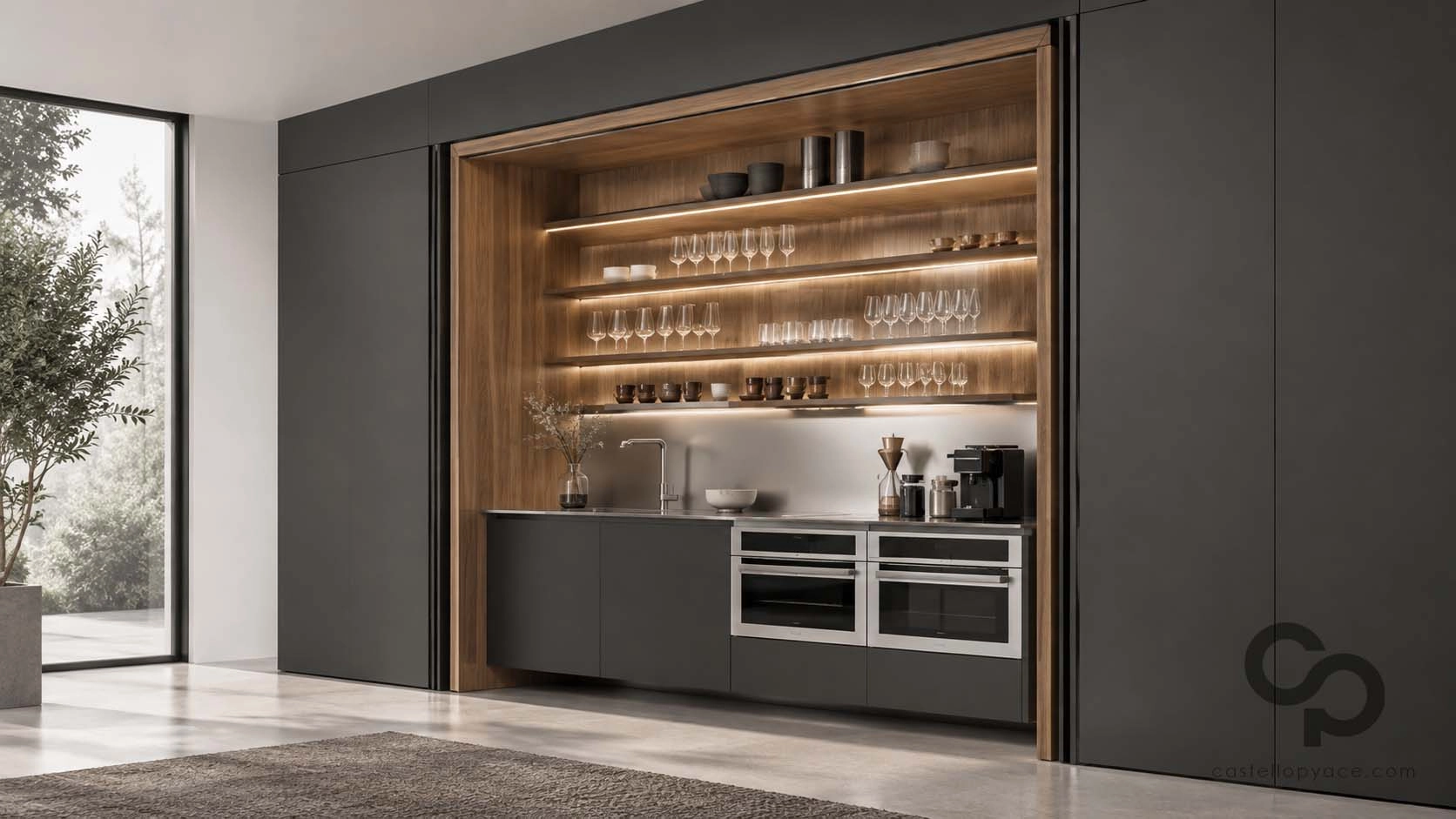
Lacquer, wood, glass, and FENIX are among the most recognizable options in contemporary European kitchen design. They are not all the same type of material, though.
Lacquer is a coating applied to a supporting surface, while wood can be used as a solid material or as a veneer. Glass is commonly incorporated into cabinet fronts, and FENIX is an advanced decorative surface material.
Understanding these differences makes it easier to compare their performance and select the appropriate finish for each part of a kitchen.
1. Lacquered Kitchen Cabinets: A Refined Finish with Design Flexibility
Lacquer remains a popular choice in luxury kitchen interiors because it gives a clean, polished look and a lot of freedom in colour and finish.
Manufacturers typically apply lacquer to a prepared cabinet substrate, creating a smooth decorative surface. Depending on the product and manufacturing process, the result can be matte, satin, or high-gloss.
Matte lacquered cabinets work particularly well in contemporary interiors. Their understated appearance complements natural stone, brushed metal, and warm wood finishes. They can also create a softer visual effect in kitchens dominated by large cabinet surfaces.
High-gloss lacquer offers a different aesthetic. Its reflective appearance can make a kitchen feel brighter and visually more spacious, particularly when combined with natural light and carefully positioned lighting.
That said, lacquer is not automatically the most durable option for every application.
Its resistance to scratches, impact, cleaning products, and moisture depends on the quality of the coating and the substrate beneath it. High-quality lacquer systems can provide excellent everyday performance, but chips or deep scratches may require professional repairs.
In humid environments, particular attention should be given to exposed edges and joints. Even when the coated surface keeps moisture out, water can still reach the supporting panel through unprotected openings.
Where does lacquer work best?
Lacquer is particularly suitable for cabinet doors, drawer fronts, and decorative panels where colour consistency and visual simplicity are priorities.
In a Dubai villa, matte lacquered upper cabinets paired with natural stone surfaces can look refined without making the kitchen feel visually heavy.
2. Natural Wood and Wood Veneer: Bringing Warmth into Luxury Kitchens
Natural wood introduces texture, warmth, and visual depth that are difficult to reproduce with artificial finishes.
In modern European kitchen design, wood is frequently used to balance the cooler appearance of stone, glass, and metal. Walnut, oak, and other carefully selected wood species can complement both contemporary and more traditional architectural styles.
There are two important options to understand: solid wood and wood veneer.
Solid wood cabinetry is manufactured using natural timber components. It offers an authentic appearance and can develop a distinctive character over time. The catch is that solid wood responds to changes in environmental moisture.
Wood can expand as it absorbs moisture and shrink as it loses it. Depending on the species, construction, and direction of the wood grain, these movements can contribute to warping, cracking, or changes in panel dimensions.
The USDA Forest Service identifies moisture content and environmental relative humidity as important factors affecting wood dimensional stability.
Wood veneer cabinetry provides a different approach. A thin layer of natural wood is applied to a supporting panel, allowing designers to achieve the appearance of genuine timber while using an engineered substrate.
This approach is widely used in premium kitchen interiors because it offers greater flexibility in panel construction and consistent use of selected wood patterns.
Veneer is still a natural wood surface, though. It requires appropriate finishing, stable supporting panels, and protection from prolonged exposure to water.
For Dubai kitchens, engineered wood panels with properly finished veneer surfaces can be a practical option when specified and manufactured correctly.
One elegant approach is walnut or oak veneer on selected cabinet fronts, kitchen islands, or open shelving, set against matte lacquer or stone surfaces.
The result adds visual warmth without requiring every cabinet surface to be finished in wood.
3. Glass Kitchen Cabinet Doors: Elegance, Light, and Visual Transparency
Glass is a good way to bring some lightness into a luxury kitchen.
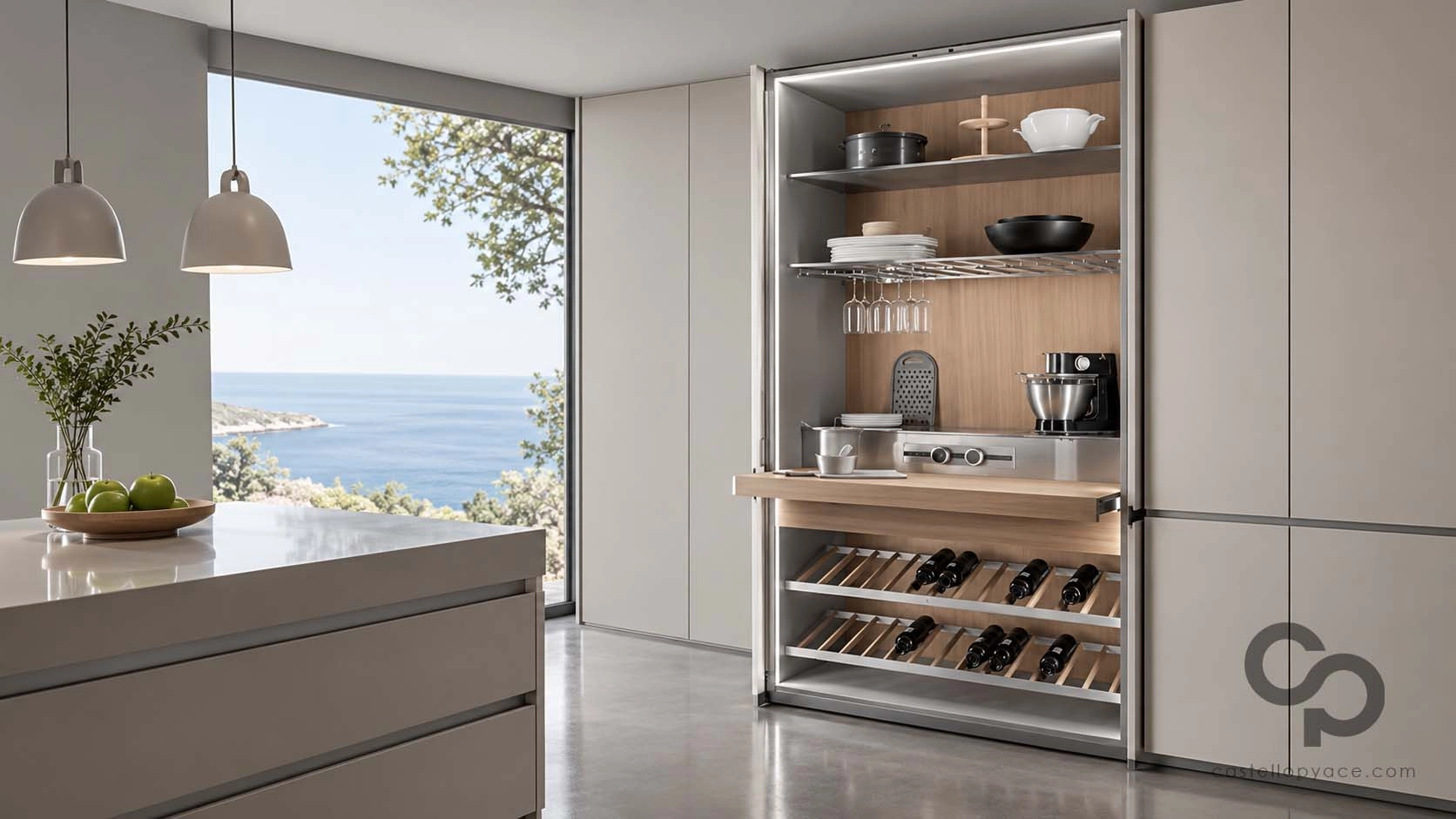
Unlike completely solid cabinet fronts, glass doors allow selected parts of the kitchen storage to remain visually connected to the surrounding space. This can be especially useful in large contemporary kitchens where designers want to create variation between closed cabinetry and display areas.
Glass cabinet fronts are available in different finishes, including:
- Clear glass for transparent display cabinets.
- Smoked glass for a darker, more contemporary appearance.
- Frosted glass for a softer and more private visual effect.
- Tinted glass for coordinated colour schemes.
- Textured glass for additional depth and visual interest.
In premium kitchens, glass is often paired with slim metal frames, integrated lighting, and well-planned internal shelving.
Tempered glass is a common choice for cabinet applications because it is designed for greater strength and safer breakage characteristics than ordinary annealed glass. The exact specification should still be appropriate for the door dimensions, installation, and intended use.
Glass also has practical limitations. Fingerprints, dust, and water marks can become noticeable, particularly on dark or transparent surfaces. Clear glass requires an organised cabinet interior because everything stored behind it remains visible.
That's why glass tends to work best in selected places rather than on every cabinet door.
A kitchen island or upper cabinet section with smoked glass fronts, for example, adds visual interest while the rest of the cabinetry stays closed and practical for storage.
Glass itself is not a solution to humidity-related problems within the cabinet structure. Frames, supporting panels, hardware, and joints still require suitable material specifications.
4. FENIX NTM: Advanced Matte Surfaces for Contemporary Kitchens
FENIX NTM has become a notable option in contemporary European interior design because it pairs a distinctive matte look with several practical surface properties.
Developed by the Italian company Arpa Industriale, FENIX uses proprietary surface technology involving acrylic resins and an Electron Beam Curing process.
Its main characteristics include:
- Extremely matte appearance with low light reflection.
- Soft-touch surface texture.
- Anti-fingerprint properties.
- Resistance to everyday surface wear.
- Thermal repairability of superficial micro-scratches.
These properties suit kitchens where designers want a refined matte finish that doesn't look like traditional painted cabinetry.
One of its most distinctive properties is its ability to undergo thermal repair of certain superficial micro-scratches. This is not the same as repairing deep cuts, chipped edges, or structural damage.
FENIX is also useful in kitchens where fingerprints and visible reflections are an aesthetic concern. Its surface treatment helps reduce the appearance of fingerprints, which suits frequently used cabinet fronts.
Even so, those technical properties don't amount to complete protection against every environmental condition.
FENIX is a decorative surface material, not a guarantee that the entire cabinet assembly is waterproof or resistant to unlimited heat exposure. The underlying panel, edge construction, adhesive system, and installation all remain important.
For a luxury Dubai kitchen, FENIX can work especially well on large cabinet fronts, handleless designs, and kitchen islands where a consistent matte finish is central to the visual concept.
Its understated look also pairs well with wood veneer, stone countertops, brushed metal, and glass.
Which Kitchen Cabinet Material Is Best for Dubai Homes?
There is no single material that is ideal for every kitchen. The most suitable choice depends on the intended appearance, usage, construction quality, and maintenance expectations.
The following comparison offers a practical starting point.
| Material | Main Design Advantage | Important Consideration |
|---|---|---|
| Matte lacquer | Smooth, consistent colours | Protect against impact and surface damage |
| High-gloss lacquer | Reflective and luminous appearance | Fingerprints and scratches may be more noticeable |
| Solid wood | Authentic natural character | Requires consideration of moisture-related movement |
| Wood veneer | Natural wood appearance with engineered support | Edges and surface coating need protection |
| Glass | Transparency and visual lightness | Requires regular cleaning |
| FENIX NTM | Ultra-matte, anti-fingerprint finish | Deep damage and substrate moisture still require attention |
For busy family kitchens, FENIX or a suitable high-quality laminate may offer practical advantages on frequently handled cabinet fronts.
Where natural materials and architectural warmth come first, wood veneer gives a more distinctive result.
Lacquer earns its place when a specific colour, a refined surface, or a seamless design is needed. Glass, meanwhile, works best as a complementary material in selected display sections.
A well-designed luxury kitchen does not necessarily need to rely on one material throughout. Combining different finishes often produces a more balanced result.
The Cabinet Interior Matters as Much as the Exterior Finish
The supporting structure beneath the visible surface is one of the most important factors in selecting kitchen cabinet materials.
A cabinet door may have a premium lacquer, veneer, or FENIX finish, but its long-term performance also depends on the panel used to manufacture it.
Common cabinet substrates include:
Standard MDF: A medium-density fibreboard frequently used in furniture manufacturing because it provides a smooth, uniform surface.
Moisture-resistant MDF: Manufactured for interior applications where occasional moisture exposure is expected. It offers improved moisture resistance compared with standard MDF, but it is not waterproof.
Plywood: Constructed from multiple layers of wood veneer bonded together. Its performance depends on the grade, adhesive system, manufacturing quality, and edge protection.
Moisture-resistant doesn't mean a board can withstand continuous water exposure.
For example, MEDITE SMARTPLY explicitly states that its MEDITE MR product is suitable for interior humid environments such as kitchens and bathrooms, but should not be exposed to direct wetting.
Edge protection is equally important. Water can enter wood-based panels through exposed edges, drilled openings, joints, and cut-outs even when their main surfaces are coated.
This is particularly relevant around sinks, dishwashers, plumbing connections, and cabinet sections close to cooking appliances.
In practice, that means choosing the right panel, sealing the edges, using suitable adhesives, and having the kitchen professionally installed.
How to Choose the Right Combination for a Luxury Dubai Kitchen
Choosing the best materials becomes easier when the kitchen is divided into functional zones rather than treating every cabinet surface in the same way.
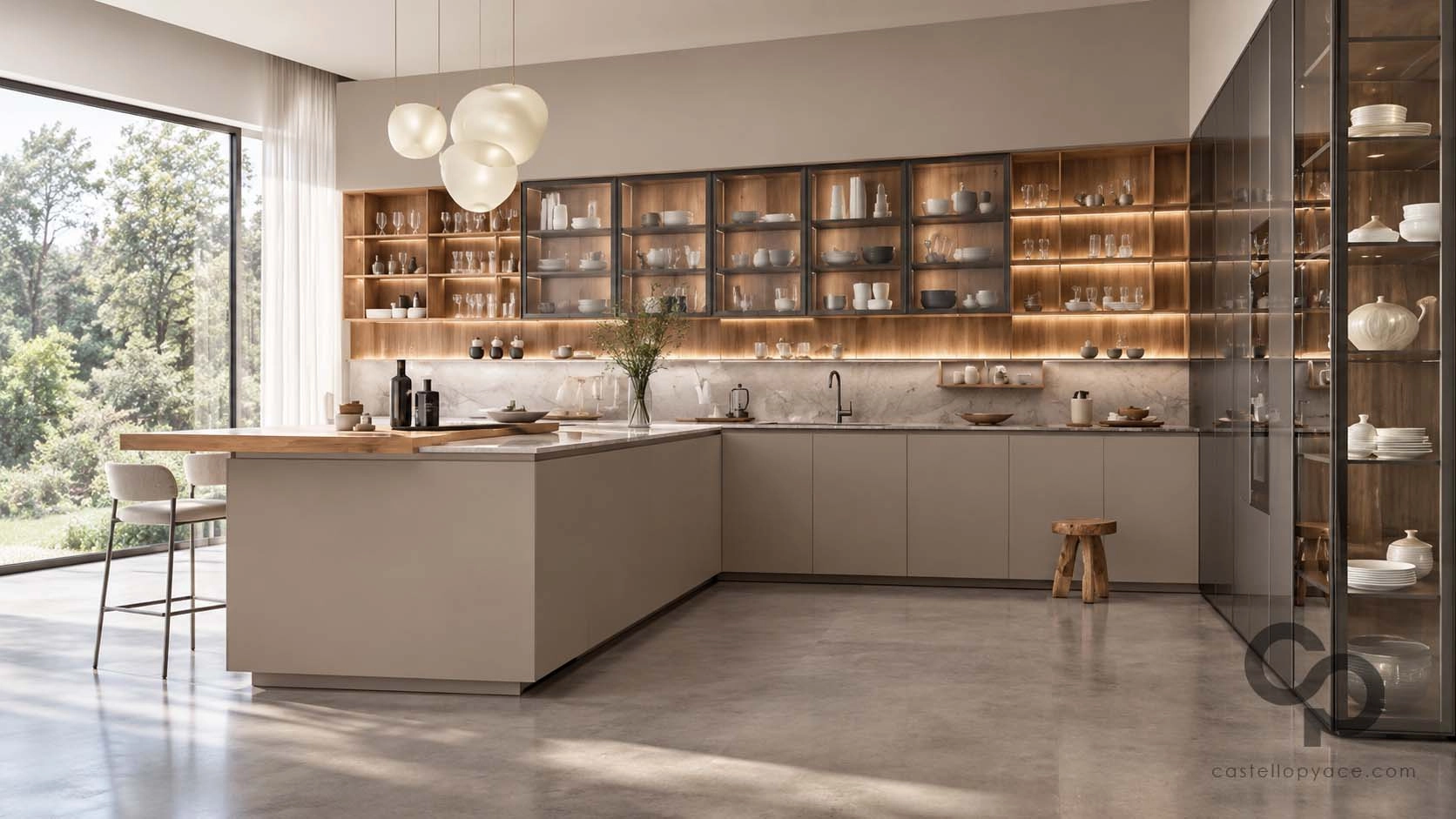
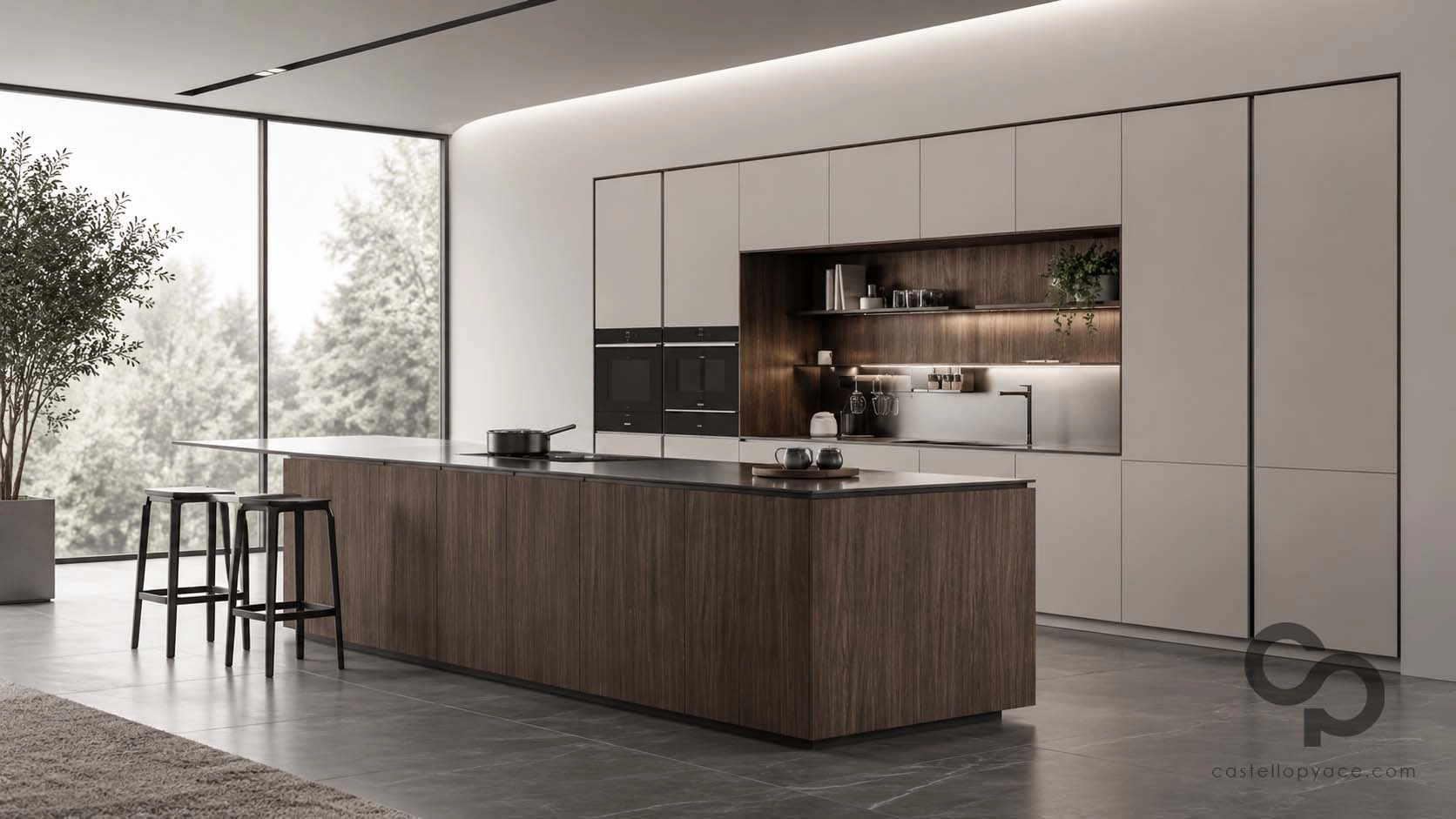
For example, a large kitchen island can use FENIX or matte lacquer to create a clean architectural centrepiece. Adjacent tall cabinets can introduce wood veneer for visual warmth, while selected upper cabinets can incorporate smoked glass.
This combination creates contrast without making the overall design feel fragmented.
For cabinets near sinks and dishwashers, the priority should be the quality of the supporting structure, edge sealing, and installation. Decorative finishes alone cannot compensate for inadequate moisture protection.
Ventilation also deserves attention. Effective extraction helps manage cooking-related steam and moisture, while properly designed appliance clearances help avoid unnecessary heat exposure to surrounding cabinetry.
Maintenance belongs in the design stage too. A family kitchen with frequent daily use may benefit from surfaces that are easy to clean and less likely to display fingerprints.
For a formal kitchen used less frequently, the design may place greater emphasis on decorative materials, glass detailing, or natural wood finishes.
The best specification is the one that ties together appearance, material performance, and how the kitchen will actually be used.
Leading Italian Kitchen Brands and Their Approach to Material Selection
European kitchen manufacturers offer extensive material collections that let architects and interior designers customise spaces in detail.
Italian brands such as Ernestomeda, Arclinea, Boffi, Valcucine, Poliform, Aran Cucine, and Molteni&C are relevant examples within the luxury kitchen and interior design market.
Ernestomeda, for example, presents an extensive material selection that includes lacquered finishes, natural wood veneers, glass, FENIX, laminates, and stainless steel. This demonstrates how different materials can be integrated into a single kitchen design concept.
Arclinea and Boffi are also established names associated with architectural kitchen design, while Poliform and Valcucine offer further options within the high-end European kitchen market.
Prophilo and Bizzotto Italia are also part of the wider Castello Pyace portfolio, and are worth exploring for luxury interior solutions.
Cabinetry is only part of kitchen design. Premium appliances need to be integrated into the overall composition.
Brands such as Miele, Gaggenau, and Bertazzoni specialise in kitchen appliances rather than cabinet finishes. Their products can complement cabinetry from manufacturers such as Ernestomeda, Arclinea, or Boffi.
This distinction is important when planning a project because the cabinet system, work surfaces, appliances, and installation details must work together.
For architects and designers working on high-end residential projects in Dubai, exploring established international brands can provide access to different material collections, design approaches, and customisation possibilities.
Castello Pyace was established to address the need for a specialised resource in the luxury construction sector. Drawing on nearly twenty years of management experience and relationships with leading international luxury brands, the company aims to support architects, designers, and internationally recognised clients with access to high-quality products and services.
Its philosophy rests on honesty, specialist knowledge, and quality solutions for luxury building and interior projects.
Final Thoughts: Selecting Kitchen Cabinet Materials for Dubai's Climate
The right kitchen cabinet material should be selected through a combination of design requirements and technical considerations. Lacquer offers colour flexibility and wood adds natural warmth, while glass brings transparency and FENIX provides an advanced matte surface with practical day-to-day properties.
The visible finish is only part of the decision, though. Cabinet substrates, moisture protection, edge sealing, and installation quality have an equally important role in long-term performance.
When comparing kitchen cabinet materials Dubai homeowners and architects should look beyond appearance and consider how each material will perform in the actual kitchen environment.
Exploring established Italian kitchen brands and their material collections can also help identify solutions that match the architectural vision of a project while meeting its practical requirements.
In a luxury kitchen, the best result isn't the most expensive finish but a well-chosen combination of materials that keeps its character and function over time.