Dubai's climate places demanding conditions on architectural materials. Summer temperatures can reach extreme levels, humidity is high, and outdoor surfaces remain exposed to intense sunlight for much of the year. Choosing flooring and wall finishes here is a decision architects and developers have to get right.
Italian Porcelain Tiles pair low water absorption and strong technical performance with wide design flexibility, so they suit projects across the UAE. Their suitability, however, depends on more than their country of origin. The tile's technical specifications, surface finish, intended application, and installation method all influence how well it performs over time.
In luxury villas, hotels, commercial developments, and contemporary residential projects, knowing these characteristics helps architects choose surfaces that look right and work in practice.
Why Dubai's Climate Requires Careful Tile Selection
Exterior building materials face several challenges in Dubai. According to the Dubai Government Media Office, average summer high temperatures are around 41.8°C, while overnight temperatures can remain close to 29.7°C. Humidity is another important factor, influenced by the city's proximity to the Arabian Gulf.
These conditions affect how flooring and wall surfaces perform, particularly in areas with direct sun exposure or frequent contact with moisture.
The main things architects need to weigh are:
- High temperatures: Outdoor surfaces receive prolonged exposure to sunlight and can become significantly hotter than the surrounding air.
- Humidity: Moisture in the atmosphere and occasional water exposure make low-porosity materials useful for many applications.
- Temperature fluctuations: Changes between daytime and nighttime temperatures can contribute to movement within exterior flooring systems.
- Dust and sand: Outdoor surfaces require appropriate resistance to abrasion and should be easy to maintain.
- Intense sunlight: Surface colour and finish must remain appropriate for long-term exposure to natural light.
Finding a tile that can take the heat is the easy part; the harder job is choosing a complete surface system that performs reliably and keeps the intended architectural look.
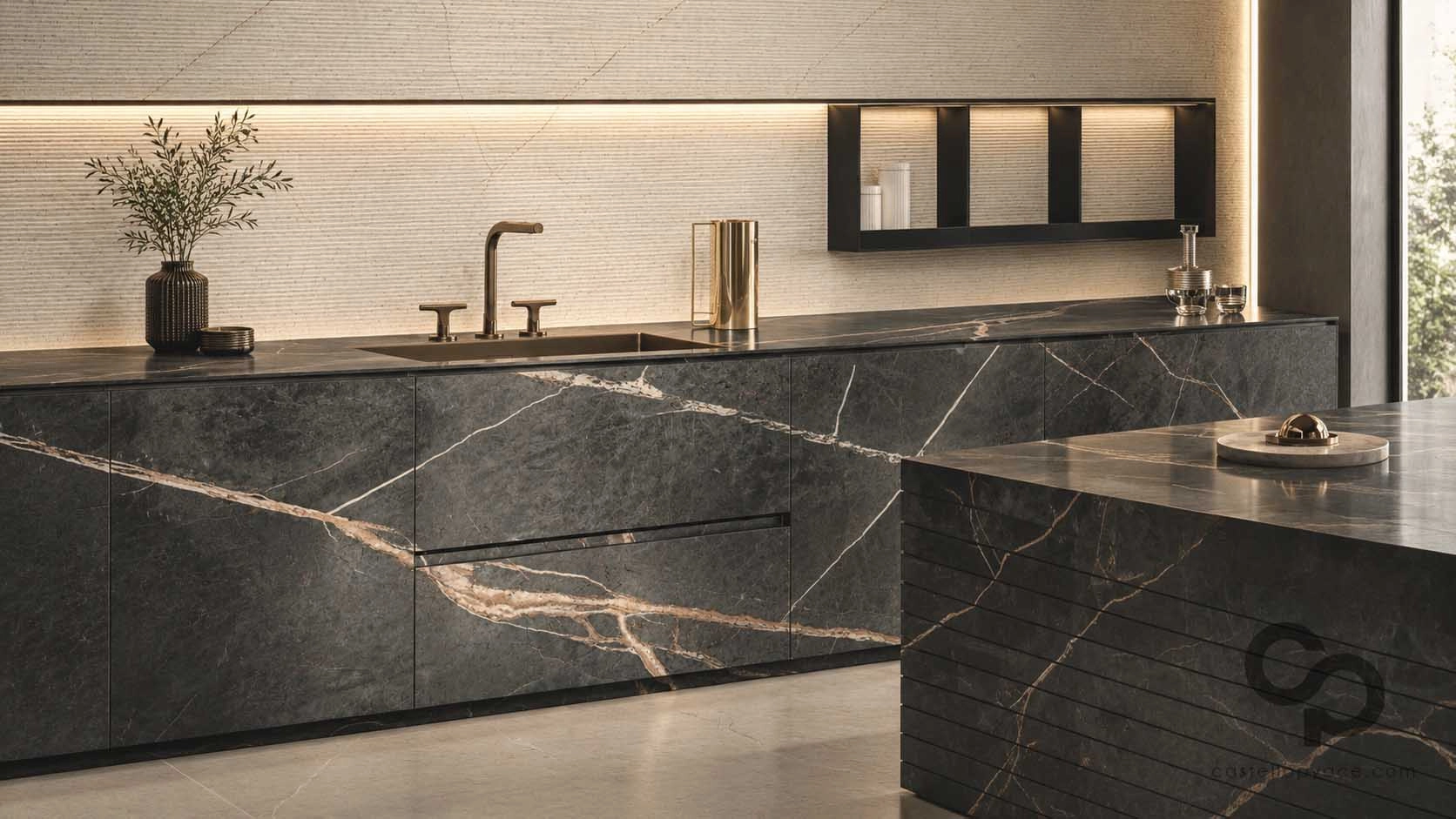
What Makes Italian Porcelain Tiles Suitable for Hot Climates?
Architects often turn to porcelain for demanding environments because of how it is made.
Porcelain tiles are produced from carefully prepared ceramic materials that are shaped and fired to achieve a highly vitrified structure. The result is a dense body with very low water absorption.
Under ISO 13006, porcelain tile is defined as a fully vitrified ceramic tile with a water absorption coefficient of no more than 0.5% by mass. It works as a practical benchmark when comparing products.
A few characteristics matter most for projects in the UAE.
Low Water Absorption and Moisture Resistance
It is the property porcelain is best known for.
Because the material is dense and has limited open porosity, it absorbs very little water compared with more porous ceramic products. This makes it suitable for many environments where regular cleaning, humidity, or occasional water exposure are expected.
For example, in a luxury villa in Dubai, porcelain flooring can be specified for living areas that connect directly to outdoor terraces. The same material family may also be used in selected bathroom and kitchen applications, provided the surface finish meets the requirements of each space.
Low water absorption, though, does not automatically make a floor waterproof. Water management still depends on correct installation, grout selection, substrate preparation, and appropriate waterproofing where required.
Resistance to Temperature Changes
Outdoor surfaces experience more significant temperature fluctuations than floors inside air-conditioned buildings.
Porcelain is manufactured through high-temperature firing, but its suitability for outdoor use should not be judged by firing temperature alone. What matters is how the finished product performs under the relevant service conditions.
ISO 10545-9 establishes a standard method for testing the thermal shock resistance of ceramic tiles. Architects and specifiers can use relevant test information to assess whether a product is appropriate for the intended application.
The tile alone does not decide how an exterior floor performs. Adhesives, substrates, grout, movement joints, and installation quality also influence the performance of an exterior floor.
Resistance to Sunlight and Colour Changes
Architectural finishes in Dubai often receive prolonged exposure to direct sunlight, especially on terraces, balconies, external walkways, and open commercial spaces.
Ceramic tiles are classified in ISO 13006 as materials that are not affected by light. That helps wherever a surface needs to keep its appearance under normal light exposure.
Architects should still read the complete product specification, particularly where a tile includes special decorative treatments, metallic effects, or other surface finishes.
The colour of a tile also influences its appearance and perceived temperature under direct sunlight. A light-coloured surface may be preferable in some outdoor settings, while darker finishes may be selected for visual contrast or a particular architectural concept.
Durability in High-Traffic Environments
Luxury developments are not always low-traffic environments. Hotel lobbies, reception areas, shopping spaces, and shared residential facilities may experience continuous pedestrian movement.
Porcelain products are available with different levels of resistance to abrasion, staining, and chemical exposure. These characteristics should be evaluated through the manufacturer's technical documentation rather than assumed from the word porcelain alone.
For projects where cleaning chemicals or maintenance products are used regularly, ISO 10545-13 provides a standard method for evaluating the chemical resistance of ceramic tiles.
It tells specifiers whether a product can handle the cleaning and maintenance expected in the building.
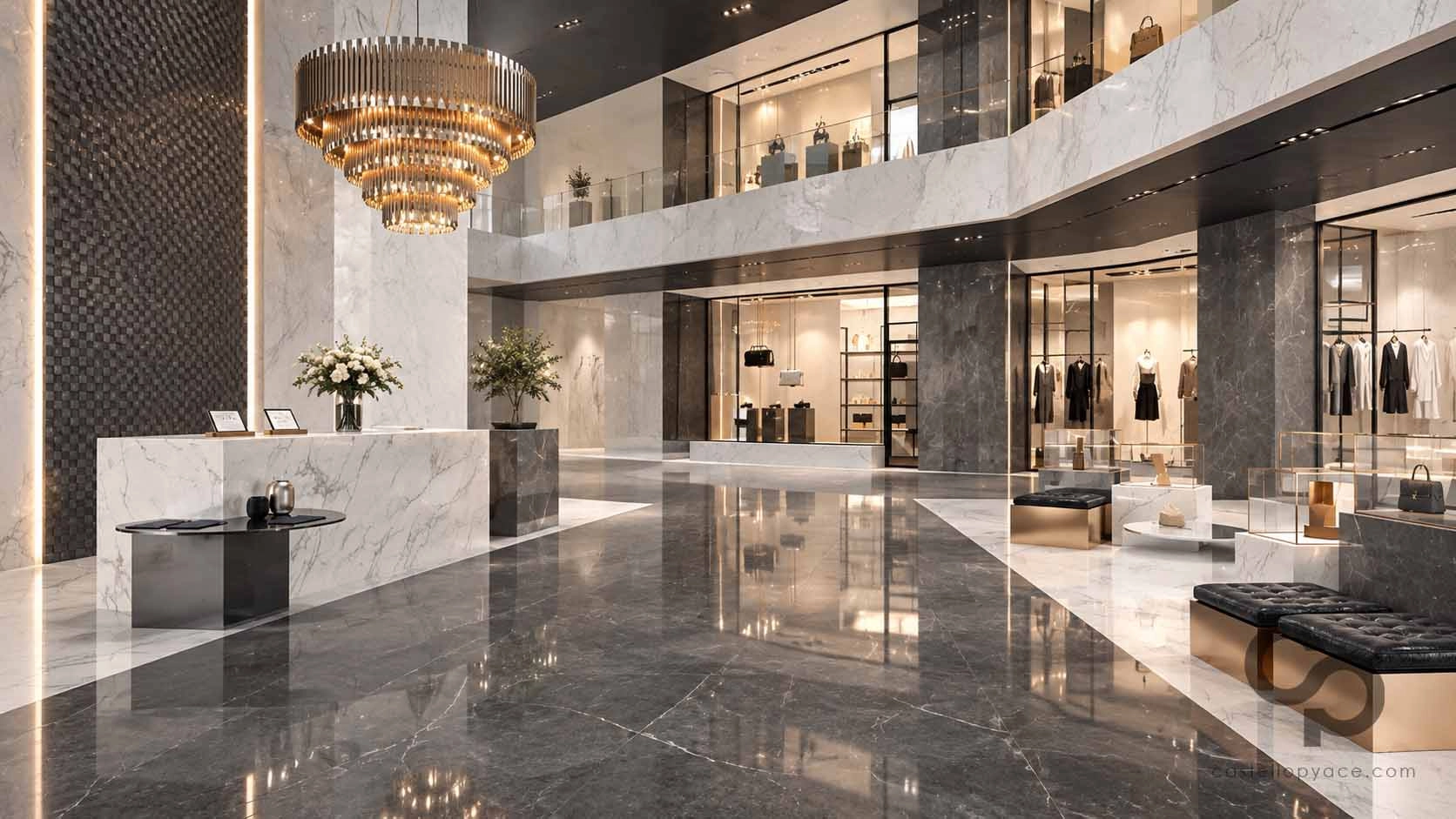
Italian Porcelain vs. Standard Ceramic Tiles: What Is the Difference?
Although porcelain and ceramic tiles are often discussed as separate product categories, porcelain is technically a type of ceramic tile.
The main difference is the degree of vitrification and the resulting water absorption characteristics.
Conventional ceramic products cover a broad range of compositions and performance levels. Some have higher porosity and may be more appropriate for specific indoor wall or floor applications. Porcelain tiles, by comparison, meet the stricter water absorption definition established by ISO 13006.
Here is how the two compare on the points architects care about most.
|
Characteristic |
Porcelain Tiles |
Other Ceramic Tiles |
|
Water absorption |
0.5% or lower under the porcelain definition |
Varies by product category |
|
Material structure |
Highly vitrified and dense |
Varies in density and porosity |
|
Moisture performance |
Suitable for many moisture-exposed applications |
Depends on absorption classification |
|
Outdoor suitability |
Available in products designed for exterior use |
Depends on product specifications |
|
Design options |
Wide range of colours, textures, and finishes |
Wide range of colours, textures, and finishes |
|
Maintenance |
Generally straightforward |
Depends on material and surface finish |
For demanding applications in Dubai, porcelain's low water absorption makes it worth a close look.
A conventional ceramic tile with the correct technical specifications can still suit certain applications. The best choice depends on the requirements of the project rather than a general assumption that one category is always superior.
Where Can Architects Use Italian Porcelain Tiles in Dubai?
Porcelain gives architects room to keep one consistent material language across several parts of a building.
Italian porcelain collections include products designed for different interior and exterior applications, which gives architects room to build a cohesive architectural concept.
Luxury Villas and Residential Projects
In luxury villas, material selection often needs to connect indoor spaces with gardens, terraces, and outdoor entertainment areas.
Porcelain flooring can be used in living rooms, kitchens, corridors, and some outdoor areas. Large-format Italian porcelain slabs also provide an opportunity to create a more continuous visual appearance across expansive spaces.
For example, a contemporary villa may use a stone-inspired porcelain surface in the main living area, with a compatible exterior finish for the adjoining terrace.
The products should be selected according to their intended use. An indoor polished finish should not automatically be specified for an exposed outdoor floor.
Hotels and Hospitality Developments
Hotel projects require materials that maintain their appearance despite frequent use.
Reception areas, corridors, restaurants, and guest facilities all have different technical requirements. Porcelain comes in a broad selection of surface finishes, so both the visual identity and the functional needs of these spaces can be met.
A hotel lobby may benefit from large-format polished porcelain, while restaurant flooring may require a finish with more suitable slip-resistance characteristics.
In these environments, cleaning requirements, pedestrian traffic, and the possibility of water or food spills should influence product selection.
Outdoor Terraces and Open Spaces
Surface performance deserves extra attention when choosing outdoor porcelain tiles in Dubai.
Terraces, balconies, garden paths, and outdoor seating areas are exposed to direct sunlight and environmental conditions that differ from those inside the building.
Architects should consider:
- Slip resistance under the expected wet and dry conditions.
- Surface temperature and colour under direct sunlight.
- Resistance to weather exposure.
- Suitable thickness and installation system.
- Drainage and movement-joint requirements.
The right product depends on the actual conditions of the space; a manufacturer calling it an outdoor tile is not enough.
Swimming Pool Surroundings
Swimming pool areas combine moisture, cleaning requirements, and regular barefoot movement.
For these spaces, the surface finish is particularly important. Architects should select tiles with suitable slip-resistance performance for wet barefoot conditions and verify the relevant classification and testing information.
A polished porcelain surface may look attractive in a product showroom but may not be appropriate for a wet pool surround.
The same distinction applies to pool interiors, surrounding walkways, and outdoor showers. Each area should have its own material specification.

How to Choose the Right Porcelain Finish for Dubai's Climate
Two porcelain tiles can share the same material classification and still perform differently in practical applications.
Their surface finish, texture, colour, and intended use all influence the final result.
Matte and Textured Finishes
Matte and textured porcelain surfaces are frequently considered for exterior flooring because they can offer better slip resistance than highly polished alternatives.
However, a matte appearance alone does not guarantee that a product is slip-resistant.
For outdoor terraces, pool surroundings, and exposed walkways, architects should request documented test results that match the expected conditions of use.
Polished Finishes
Polished porcelain is commonly selected for high-end interiors where a refined appearance and light reflection are important.
It can work particularly well in residential living areas, hotel receptions, and certain commercial interiors.
For areas that may become wet, the slip-resistance rating must be checked carefully. A finish designed primarily for decorative interior applications should not be assumed suitable for every floor.
Large-Format Porcelain Slabs
Large-format Italian porcelain slabs are now a common choice in contemporary architectural design.
Their larger dimensions allow designers to reduce the number of visible grout lines and create a more continuous surface.
They can be used for:
- Feature walls and decorative interior surfaces.
- Kitchen islands and some countertop applications.
- Bathroom walls and floors.
- Large residential living areas.
- Certain exterior architectural surfaces.
Large slabs also require careful handling and installation. Their weight, dimensions, substrate conditions, adhesive coverage, and joint layout need to be considered during specification and construction.
Why Italian Tile Manufacturers Matter to Architectural Projects
Italy has a well-established ceramic manufacturing sector, built on specialised production regions, a deep pool of manufacturers, and ongoing investment in industrial processes.
According to Confindustria Ceramica, Italy had 117 ceramic tile manufacturing companies in 2025, producing approximately 390.9 million square metres of tiles. Porcelain stoneware accounted for more than 90% of Italian ceramic tile production. Approximately 80% of the sector's sales were directed towards international markets.
Those numbers show how large the Italian ceramic industry is and how far its products travel.
For architects, that expertise translates into a wide choice of materials, finishes, formats, and design collections.
Italian ceramic producers also offer different approaches to architectural design. Some collections focus on the appearance of natural stone, while others explore concrete, marble, wood, and contemporary abstract surfaces.
That range suits projects where technical performance and visual identity have to work together.
Still, Italian origin should be considered alongside product-specific evidence. A reliable specification should include the manufacturer's technical data, relevant test results, product classification, and recommendations for the intended installation.
What Architects Should Check Before Specifying Porcelain Tiles
Picking a tile because it looks good is just the first step in specifying it.
For projects in Dubai, architects and consultants should examine the technical documentation before approving the final material.
The points to check are:
- Water absorption classification
Check whether the product meets the porcelain definition under ISO 13006, with water absorption of no more than 0.5%. - Thermal shock resistance
Review available test results and manufacturer recommendations for the intended exposure conditions. - Slip resistance
Specify a suitable surface finish and obtain the relevant test classification for the intended environment, particularly in wet outdoor and barefoot areas. - Abrasion and chemical resistance
For commercial spaces and areas requiring regular cleaning, check the relevant product test information. - Exterior installation requirements
Confirm that the tile is approved for exterior use and that the proposed installation system is appropriate for the substrate and environmental exposure. - Movement joints and drainage
Exterior floors need a properly designed joint layout and a suitable drainage strategy.
Thermal and moisture movement can create stress within an exterior tiled floor. The Tile Association highlights the importance of movement joints in managing this stress and reducing the risk of cracking, lifting, and loss of adhesion.
Large-format porcelain installations make this planning particularly important because the tile layout, substrate, and joint design must work together.
The Role of Italian Porcelain in Luxury Architectural Design
Technical performance matters, but materials also shape how a building feels and looks.
In luxury developments, flooring and wall surfaces help define the character of a space. Their colour, texture, format, and relationship with natural light can influence the atmosphere of an entire interior.
Italian ceramic collections give architects plenty of freedom here.
Stone-inspired porcelain can introduce the visual character of natural marble without requiring the same material characteristics or maintenance approach as natural stone. Concrete-inspired finishes can support minimalist architectural concepts, while wood-effect collections can create a warmer visual environment.
Large-format surfaces can also help maintain design continuity between different areas of a property.
Picture a contemporary villa: the architect might choose a marble-inspired porcelain collection for interior feature walls, coordinate the flooring with a compatible finish, and introduce a different slip-resistant surface for the exterior terrace.
The result is a more consistent material palette without requiring every space to use an identical finish.
For CASTELLO PYACE, material expertise, architectural understanding, and premium international brands all come into play here. Choosing the right surface means more than finding an attractive tile; it means identifying materials that support the project's design vision and technical requirements.
Conclusion
Italian porcelain combines low water absorption, a wide choice of architectural finishes, and the technical characteristics required for many demanding building applications. These qualities make it a strong option for residential, hospitality, and commercial projects in Dubai.
Successful specification, though, depends on selecting the right product for each application. Slip resistance, thermal performance, installation requirements, and manufacturer documentation should all be considered before making a final decision.
For architects and developers planning premium projects in the UAE, Italian Porcelain Tiles make it possible to pair careful material selection with the design range of established Italian manufacturers.
CASTELLO PYACE brings together premium architectural materials from respected international brands and helps architects and designers find surfaces that fit the vision and requirements of their projects.
Working on a project where the surface matters?
Every project at CASTELLO PYACE is built around authentic Italian porcelain and ceramic brands. Visit our website to see the collections, or talk to our team about the right material for your project.